As prepared remarks by UN Women’s Sofia Calltorp and Susan Ferguson at today’s press briefing at the Palais des Nations in Geneva.
As prepared remarks by UN Women Chief of Humanitarian Action Sofia Calltorp – to whom quoted text may be attributed
GENEVA / KABUL – “I have just returned from Afghanistan, where the systematic attack on the freedoms of women and girls continues.
Since taking power in 2021, the de facto authorities have issued more than 100 decrees stripping women and girls of their rights.
Women are banned from many public spaces and most places of work.
Some 2.6 million girls have been banned from secondary education, which is projected to push more girls into child marriage and increase maternal mortality.
We are now seeing the deepening of yet another assault on the rights of Afghan women and girls: the growing exclusion of women from providing healthcare and, over time, a growing risk that Afghanistan’s 22 million women and girls will be denied access to it.
This is the result of the ban on women training in these professions and restrictions in many communities on male healthcare workers treating women and girls – making it significantly harder for sick or pregnant women and girls to access care.
One woman I met in Kunar told me she had suffered multiple miscarriages without access to healthcare. I also met with men who spoke of restrictions preventing them from supporting women.
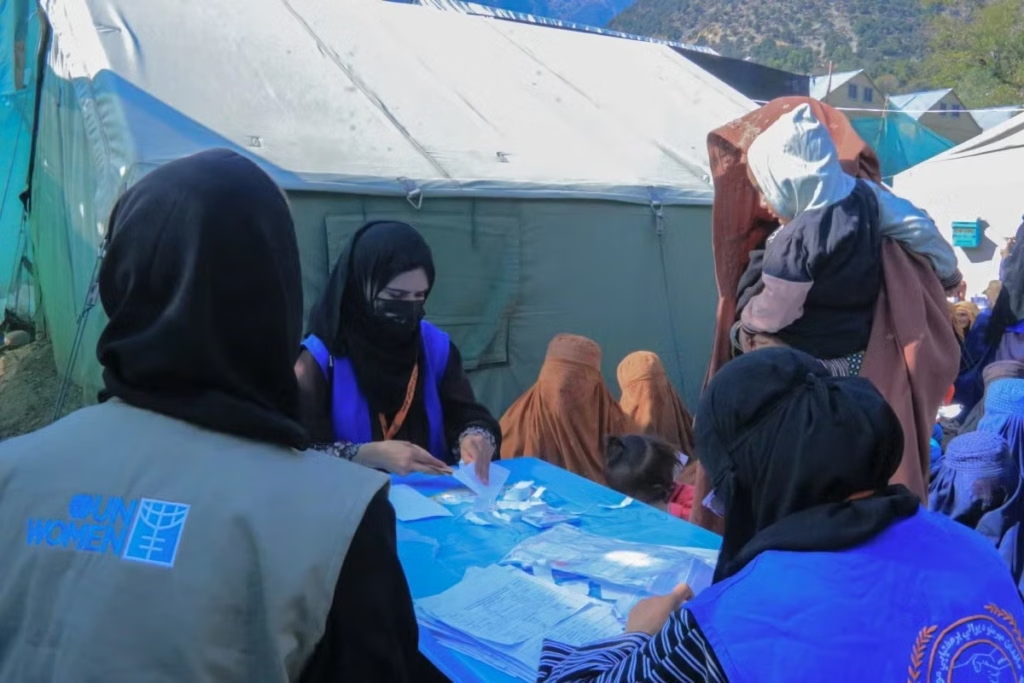
In Kunar, three hours from Jalalabad, I met women facing their second winter displaced from their homes after losing everything in an earthquake last year. Many had since been displaced again by the hostilities with Pakistan or severe flooding in recent months.
Through UN Women, they receive emergency cash assistance, counselling, and small business training. These services are critical, but they do not undo the wider restrictions, which have also removed the guardrails against violence and abuse at home.
In Kabul, where UN Women is supporting family counselling, I heard another heartbreaking account: that of a 24-year-old woman who for 18 months was detained in her own home by her father.
She was often abused and left without food. In her own words: “I feel like life is not meant for me.” It was only when she and her father participated in a programme designed to prevent and protect women from violence that her life turned around – and her father stopped abusing her. The programme is run by a local women’s organisation, one of many supported by UN Women across Afghanistan.
In Afghan women, I saw strength and extraordinary courage – and the ability to carry what no person should have to bear; women who continue to find ways to survive, to care for their families, to support one another, and to hold on to hope.
We cannot accept this as normal.”
As prepared remarks by UN Women Special Representative in Afghanistan Susan Ferguson – to whom quoted text may be attributed
GENEVA / KABUL – “Thank you, Sofia, for coming to Afghanistan to meet with Afghan women and girls, and the women’s organisations that support them.
I know you heard the same message I hear repeatedly from Afghan women and girls:
‘See us. Don’t forget us. Stand with us.’
UN Women is staying and delivering.
Working with women’s organisations, we provide counselling, vocational training, literacy, food packages, emergency cash, and more.
But the needs are vast. And they are growing.
On top of the restrictions on their rights and freedoms, Afghan women and girls are being hit by crisis after crisis.
Poverty is rising, compounded by soaring prices for basic goods.
More than 1.5 million Afghan women and girls have returned from Iran and Pakistan since January 2024 – many forcibly, and some arriving in a country they have never known as home.
Meanwhile, climate shocks are intensifying.
A UN Women survey of more than 3,000 people found that three-quarters had experienced at least one serious environmental shock in the past year.
These shocks exposed up to 16 million women and girls to risks including displacement, loss of access to safe water and shelter, and protection threats.
Yet, just as needs are growing, international aid is shrinking.
In the world’s worst women’s rights crisis, funding cuts are forcing impossible decisions about which women and girls can receive support – and which must be turned away.
This year alone, as a result of aid cuts in Afghanistan, according to OCHA, UN Women and other humanitarian actors:
- Nearly 300 humanitarian health facilities have been closed or suspended, affecting more than one million women and girls;
- More than 193 service points for gender-based violence survivors have been closed, affecting more than one million and girls; and
- Around 3.4 million women and girls in need are now unlikely to have access to water, sanitation, and hygiene services.
It’s impossible to comprehend the kind of pain and deprivation each woman behind these numbers is experiencing.
Yet, women continue to find ways to survive, to help others and advocate for change.
We need to look behind the figures and recognise the strength of women in this country and their hope that things will change.
Women and girls desperately need the services they are losing access to.
And the women’s organisations working to reach them are under extraordinary pressure.
In Afghanistan, where assistance must be delivered by women, for women, these organisations are irreplaceable.
They have spent years fighting to meet the needs of women and girls in some of the most horrific circumstances imaginable.
Now, they are fighting for their own survival.
A UN Women survey of 74 women-led organisations across Afghanistan this year found that half expect to suspend operations or close by April 2027 because of aid cuts.
Up to 427,000 women are estimated to be at immediate risk of losing access to services if these women’s organisations are forced to close their doors.
I urge all governments and other international donors to stand with us and with Afghan women and girls.
Stay the course and increase, not cut, your support. Back these women.
And do everything you can to advocate for the rights and freedoms of Afghan women and girls in every room you are in, every room where decisions are made, and every room from which Afghan women are now excluded.”
Originally published by UN Women