What is life like for women and girls in Afghanistan right now? Explore the data, and learn what the world must do to stand with Afghan women.
It is now five years since the Taliban takeover in Afghanistan – the second time they seized power in the country. Since August 2021, the de facto authorities (DFA) have issued more than 100 decrees affecting women and girls, stripping them of their rights and institutionalising discrimination against them.
In the past year, this organised exclusion of women and girls from education, health services, and work – and restrictions on their movement and access to public life – has only intensified.
No other country in modern times has dismantled the rights of half its population through law, policy, and practice to the same extent. At the same time, overlapping humanitarian and economic crises and deepening poverty are also having a disproportionate impact on women and girls.
Half a decade in, the most severe women’s rights crisis in the world is being normalised.
Key 2026 Taliban decrees restricting the rights and equality of women and girls
- Decree No. 12 removes equality between men and women before the law, placing husbands in a position of legal authority over their wives and limiting women’s access to justice. It only criminalises violence within marriage when it causes severe and visible physical injuries.
- Decree No. 18 makes it significantly harder for women to leave a marriage while preserving men’s unilateral right to divorce. It also implicitly permits child marriage, further eroding the rights of women and girls.
- Enforcement of these and other restrictions has intensified under the Law for the Propagation of Virtue and Prevention of Vice (PVPV), with thousands of officials granted broad powers of detention and surveillance.
Is it safe to be a woman in Afghanistan?
The short answer: no – and the risks are rising.
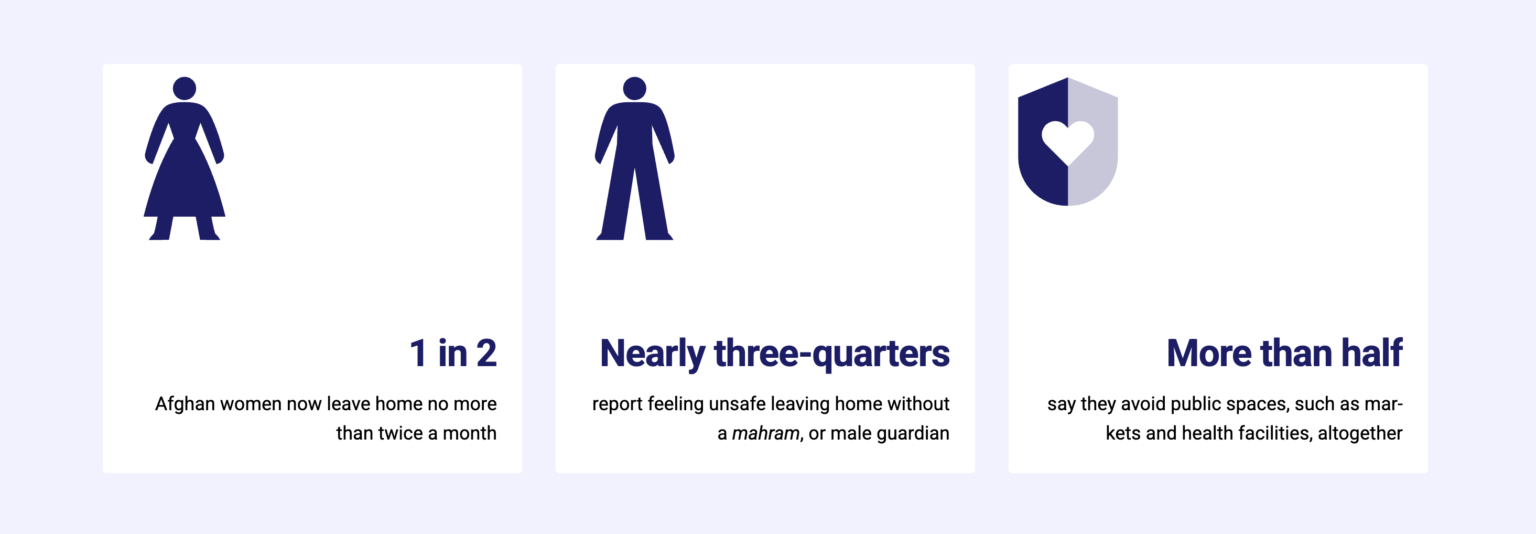
Despite a marked decline in large-scale armed conflict, life for women at home and in public spaces has in many ways become much less safe, largely due to the many decrees issued by the de facto authorities and the growing system of surveillance and enforcement by thousands of men and women with wide-ranging powers to detain people. This has led to a palpable sense of fear and insecurity, felt sharply by women and girls. According to new UN Women data:
Increased risk of violence and less access to justice
Since the Taliban’s return to power in 2021, economic hardship, restrictions on girls’ education, and the dismantling of laws and services to prevent and respond to violence have increased the risk of violence against women and girls.
At the same time, women in Afghanistan are nearly four times less likely than men to have access to formal justice mechanisms, highlighting a widening justice gap that is leaving many women without safe avenues to assert their rights, seek protection, or challenge abuse.
Rates of early, forced, and child marriage remain high – and are rising. In 2023, nearly 30 per cent of Afghan girls under 18 were married, including 10 per cent under the age of 15. Some families, facing poverty, marry off daughters as a survival strategy.
Can Afghan women access healthcare today?
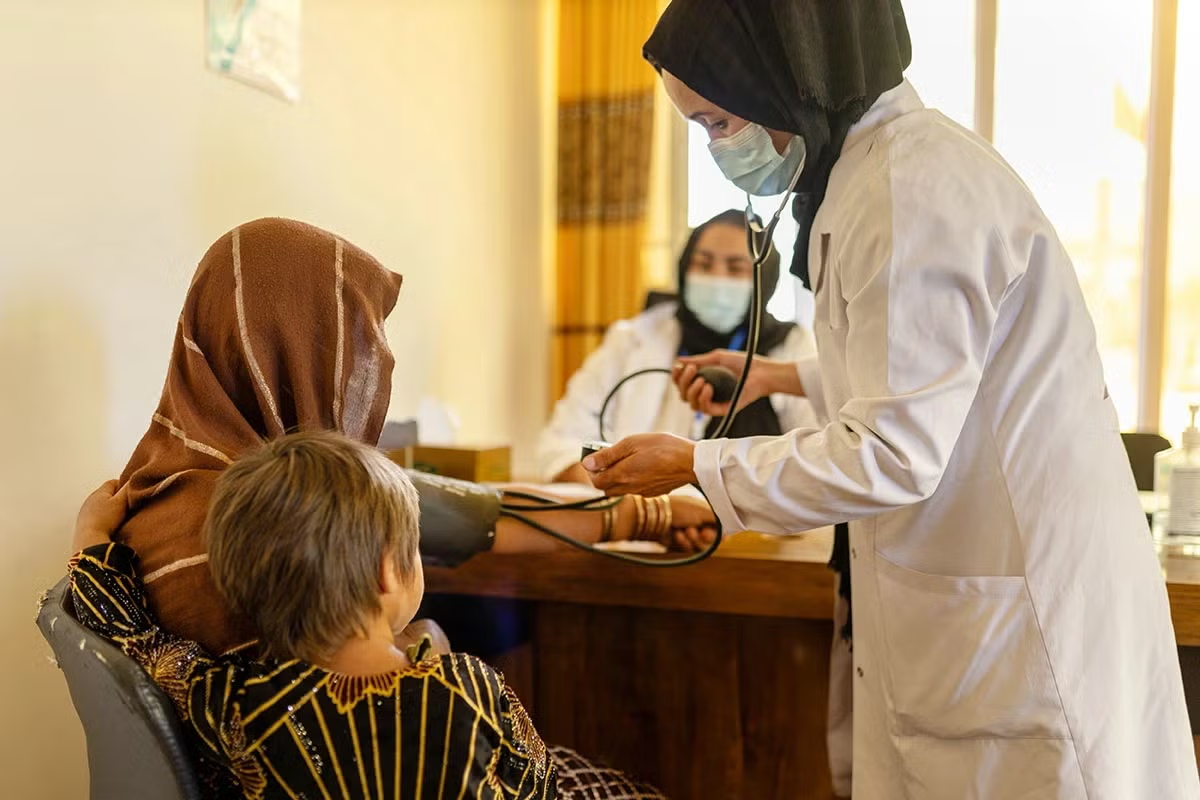
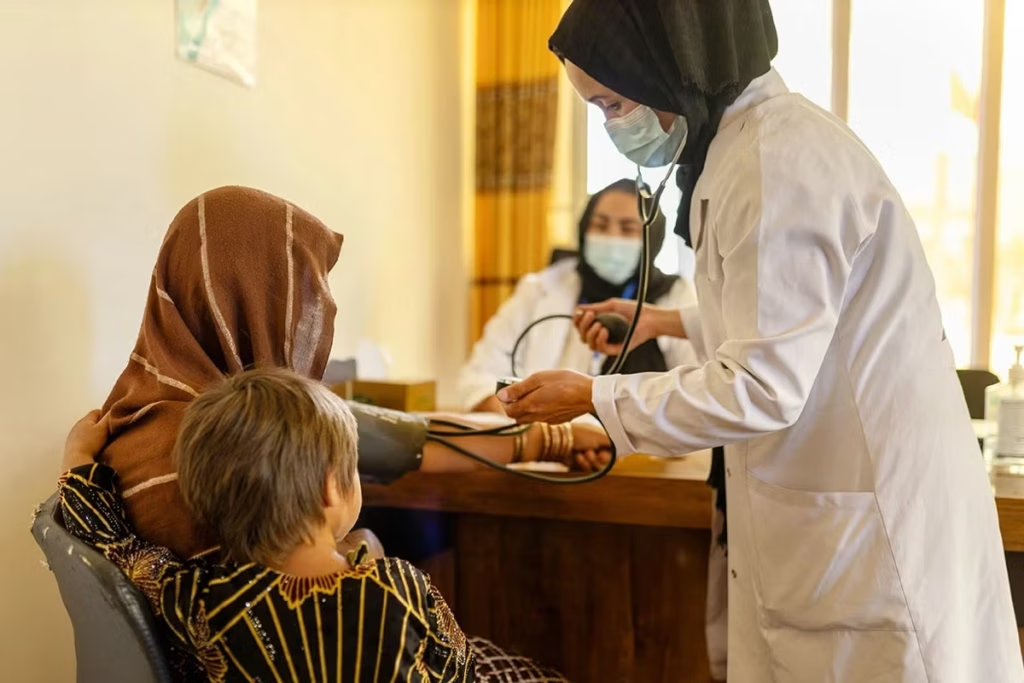
Accessing healthcare has become increasingly difficult for Afghan women. Since the Taliban takeover, fear, mobility restrictions, education bans, and systemic discrimination keep women and girls from getting the care they need.
The de facto authorities have also banned women from studying medicine, including midwifery – closing one of the last pathways for them to become healthcare providers.
Worsening maternal health
Growing shortages of women health workers, global aid cuts, and limited access to essential medicines are contributing to preventable maternal and neonatal deaths. Afghanistan already has one of the world’s highest maternal mortality rates, with an estimated 638 maternal deaths per 100,000 live births in 2024 – the seventh highest globally.
In some communities, the shortage of women health workers means many women are unable to receive care due to rules restricting treatment by male doctors.
The results are alarming: many women are living shorter, less healthy lives. The restrictions on education for women and girls alone could lead to an increase in maternal mortality rates by at least 50 per cent, as there is no pipeline of trained Afghan women nurses, midwives and doctors entering the healthcare system.
Effects on mental health for women and girls
Being confined to the home also has profound mental health consequences. The loss of rights and opportunities, as well as limited access to physical activity, community, and emotional support, has triggered a mental health crisis among women and girls, who report rising levels of anxiety, hopelessness and despair.
- Seven in ten women now describe their mental health as ‘bad’ or ‘very bad.’
- Nearly two-thirds say their lives have turned out worse than they had expected before the Taliban takeover.

Why can’t girls go to school in Afghanistan?
When Afghan girls walk out of the school gates on the last day of grade six, their formal education is over. Since September 2021, the Taliban has banned girls from secondary school.
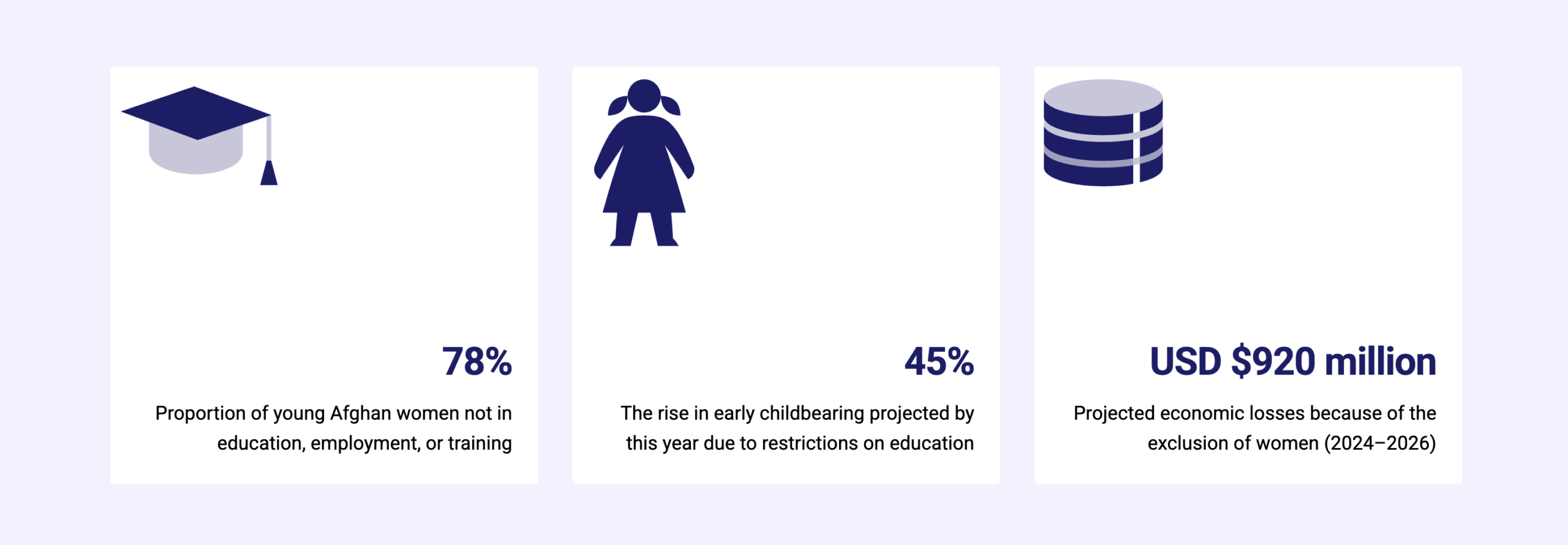
But the crisis begins even earlier: nearly 30 per cent of Afghan girls never start primary school due to poverty, restrictive gender norms, and safety concerns. Families often withdraw both girls and boys from school to contribute to household income or prepare for child marriage, which has been on the rise as families struggle to cope with the economic crisis.
A few informal or online learning options exist, but they reach only a small fraction of girls and are no substitute for formal, full-time learning. They are also not a pathway to high school or a job.
Are Afghan women allowed to have jobs?
Afghanistan now has one of the largest workforce gender gaps in the world. Only seven per cent of women are employed, compared to 84 per cent of men.
This is no accident. The Taliban issued sweeping bans that barred women from working in sectors that once offered employment opportunities, such as the civil service, national and international NGOs, and beauty salons.
Many women who do work are forced into low-paying, unstable jobs in the informal economy. Even accessing money is a challenge: less than seven per cent of Afghan women have a bank account or use a mobile money service.
Threats to the women’s organisations providing critical support to Afghan women and girls
Women’s organisations remain one of the last lifelines for Afghan women and girls, delivering life-saving services including protection from violence, healthcare, mental health and psychosocial support, livelihoods, and other types of humanitarian assistance.
Yet, restrictions on movement, combined with severe aid cuts, have put intense pressure on these organisations – one of the last remaining lifelines for Afghan women and girls.
More than half of women-led organisations in Afghanistan expect to suspend operations or close within the next year because of international aid cuts, according to a UN Women survey of 74 women-led and women’s rights organisations in Afghanistan.
To understand the impacts of aid cuts and restrictions from the de facto authorities, the Afghanistan Gender Coordination Group recently surveyed organisations operating around the country. It found:
- 54 per cent of organisations reported they had let Afghan staff go due to funding cuts.
- 44 per cent of organisations said they were now unable to cover the participation costs of women staff (for example, the cost of hiring mahrams) due to funding cuts.
Can women participate in politics in Afghanistan?
Women are completely excluded from formal political life in Afghanistan. In 2020, Afghan women held over 25 per cent of seats in Parliament and could run for president. Today, they hold no positions in the de facto cabinet.
Some women continue to find other ways to engage, meeting informally with the DFA to advocate for their organisations and communities. These quiet acts of influence matter but are no substitute for equal representation.
There are no images of women in public office, on television or at official events. The message to girls and women is clear: Leadership is not for you.
Even in their private lives, women’s influence is shrinking. UN Women data shows a 60 per cent drop in the number of women who feel they can influence decisions even within their own households.
Can women still have influence in Afghanistan?
Afghan women and girls continue to find ways to navigate and resist the tightening constraints on their lives.
Despite near-total restrictions, they still run businesses and work on the front lines as humanitarian workers, journalists, and community leaders.
They continue to advocate for their rights – and the rights of all Afghans.
How does UN Women work with women and girls in Afghanistan?
UN Women remains on the ground in Afghanistan, meeting immediate needs while safeguarding the future of Afghan women and girls. Our support includes:
- By women, for women programming, working with women’s organisations – including women leaders, human rights defenders, journalists and more.
- Expanding support for women entrepreneurs through capital, training and access to markets.
- Delivering integrated services including psychosocial support, humanitarian services, and livelihood activities to reach the most marginalised and vulnerable women and girls.
- Amplifying the voices of Afghan women in international decision-making platforms.
- Documenting the impact of the women’s rights crisis on the ground.
How can the international community support women in Afghanistan?
UN Women urges global partners to:
- Allocate long-term flexible funding: Support women’s civil society organisations with sustained, adaptable resources.
- Ensure at least 30 per cent of funding to Afghanistan supports gender equality: Avoid programming that does not explicitly address the needs of both men and women, boys and girls. Make women’s rights central to all efforts.
- Don’t normalise discrimination: Prevent actions or partnerships that could unintentionally support or normalise the Taliban’s discriminatory policies.
- Integrate women’s rights across all humanitarian action: Human rights, especially women’s rights, must be foundational to aid and development responses.
Data cards sources: Afghanistan Gender Index 2024, UN Women; ibid; Afghanistan Socio-Economic Review 2025, UNDP