Remarks by Sofia Calltorp, UN Women Chief of Humanitarian Action – to whom quoted text may be attributed – at the press briefing at the Palais des Nations in Geneva on 10 July
[As prepared]
Today UN Women is launching a new report on the impact of aid cuts on women’s organisations – and the women and girls that they serve. The findings are disturbing.
Since January 2025, at least one million women and girls affected by conflict and crisis have lost access to critical services and support.
UN Women has spoken to 855 women’s organisations working in 52 countries who have told us that these women and girls have been turned away due to funding cuts that are dismantling their organisations.
We know that this number, at least one million women and girls, is just the tip of the iceberg.
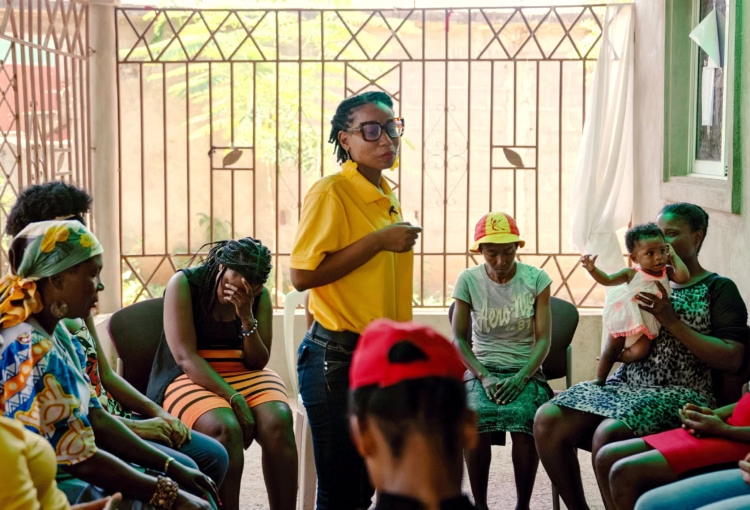
If you have ever been in a war or disaster zone, you will know that women’s organisations are the muscle and lifeblood of the humanitarian response. They are the first to respond and the last to leave during crises.
They work on the frontlines of the world’s most complex and dangerous crises – in Afghanistan, the Democratic Republic of the Congo, Sudan, and Yemen – serving the communities they are closest to.
In some cases, their staff, who are mostly women, go where international actors cannot – facing huge risks and personal sacrifice by doing so.
Needs and demand for their services are outpacing the support available, which is itself shrinking.
Eight in 10 have seen an increase in demand for their services since January 2025. Yet, more than 9 in 10 women’s organisations that we spoke to told us that they cannot meet the current levels of need.
Three quarters have been forced to cut staff.
Just as we record the highest levels of armed conflict the world has experienced in decades, 4 in 10 women’s organisations working in humanitarian crises expect to close in the next 12 months.
Cases of conflict-related sexual violence doubled in 2025 and yet nearly two thirds of women’s organisations have told us that safe spaces and gender-based violence services have been significantly reduced or are no longer available in their communities.
This is a cruel paradox.
Nearly two thirds of the organisations we surveyed told us their staff are working without pay to keep critical support for women and girls afloat.
These sacrifices are a testament to their commitment, but the expectation cannot be that women absorb these costs.
There are already signs that they are being pushed beyond the breaking point. Almost half report rising burnout among their teams.
And let’s be clear. The cuts to women’s organisations are happening at the same time we are seeing women’s rights being eroded – and these two things are so deeply connected.
9 in 10 women’s organisations that we spoke to said that they have seen an increase in poverty among the women they serve, 8 in 10 have seen an increase in girls dropping out of school, and 7 in 10 have seen an increase in forced marriage.
We are seeing how defunding of women’s rights and gender equality in humanitarian settings have fueled insecurity. But the reality is that when you invest in women’s protection and leadership, communities strengthen and peace lasts longer.
And yet, 1 in 5 organisations has already suspended work that is designed to advance women’s leadership and gender equality, and more than half are already seeing less women participate in community leadership and local decision-making.
Funding shortfalls deepen inequality and division – both of which comes with an incredibly costly price tag. And the irony is that women’s organisations are highly cost-effective.
UN Women calls for immediate action from donors and the humanitarian community to prioritise funding for women’s organisations. need multi-year support that allows them to plan, retain staff, and strengthen their institutions. And they need to be part of decisions about resources and responses.
UN Women is working to make this happen. We are on the ground in crisis and conflict-affected countries around the world, working together with women’s organisations to strengthen their leadership, capacity, and ability to reach all women and girls. We will not and cannot allow them to become another casualty of war.
Beyond the breaking point: The continuing impact of funding cuts on women’s organisations in humanitarian settings
Originally published by UN Women